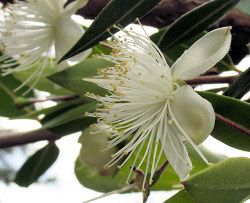

Myrtus Communis

Myrtle Tree

Evergreen shrub or small tree, up to 5 metres in height.  The flowers are pollinated by bees amongst some other insects, and the seeds are dispersed by birds which feed on the berries.  A rare species that grows in maquis and rocky slopes and rapidly decreasing in the wild.  Imported stock of myrtles (known as the ‘tarentina’ variety) is often visibly different from native stock by having smaller and more compact leaves.

Leaves 3-5cm long, lemon scented, opposite oval-lanceolate, pointed, and glossy green.

Flowers borne in summer are white, 2 cm across with rounded petals and a central spray of white stamens.

Fruits are small black or white berries.

Propagation Notes

  1. Place the seeds in the refrigerator and keep them there for about one month, or preferably up to two months.
  2. Prepare a mixture of compost and perlite in a 2:1 ratio, that is, use double the volume of compost. You can also add a little garden or field soil (ordinary soil).
  3. Sow and cover with a little soil, about 1 cm deep.
  4. Place in light but not in direct sunlight, for example in a shaded courtyard.
  5. Sow at the end of February, when the days start to warm up.
  6. Water lightly and regularly so that the soil always remains moist.
  7. They germinate about 3 or 4 weeks after sowing.

Stephen Mifsud