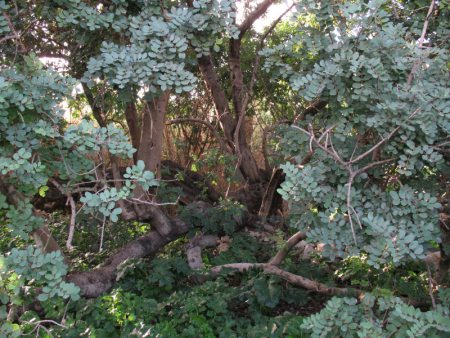

Ceratonia Siliqua

Carob Tree

Evergreen tree growing to about 10 meters. Grows in maquis and in valleys, in cultivated areas and close to the rural buildings.  It is a common tree but its natural habitats are in decline.  It was used by our forefathers as fodder for their livestock.  The pods of these trees are still used to produce a carob syrup better known as ‘ġulepp tal-ħarrub’.

Compound pinnate leaves comprise 2–5 pairs of ovate, leathery leaflets, with a notched tip and slighty wavy margin.

Greenish flowers without petals, in small inflorescences carried on the older branches, appearing at the same spot year after year.  Male and female flowers usually occur on different trees.  Blooms in autumn (typically October), when the strong scent of male flowers fills the air.

Fruits are 10–20 cm long pods or locust beans forming only on female trees.

Propagation Notes

  1. Place the seeds in hot water at about 70–80°C and leave them there for one day. Do not use boiling water. You can boil the water, wait 10 minutes, and then place the seeds in it; alternatively, you can use hot water from the water heater, which is usually at this temperature.
  2. Collect and use the seeds that sink under the water (those that remain on the surface are not good).
  3. Prepare a half-and-half mixture of garden or field soil and compost.
  4. Sow the seeds 2–3 cm under the soil in shallow pots and place them in a sheltered spot in the shade, but not in darkness. Do not place them where there is direct sunlight.
  5. You can plant in October or, preferably, in March.
  6. Water lightly and regularly so that the soil always remains moist.
  7. They germinate about 3–4 weeks after sowing.

Stephen Mifsud